
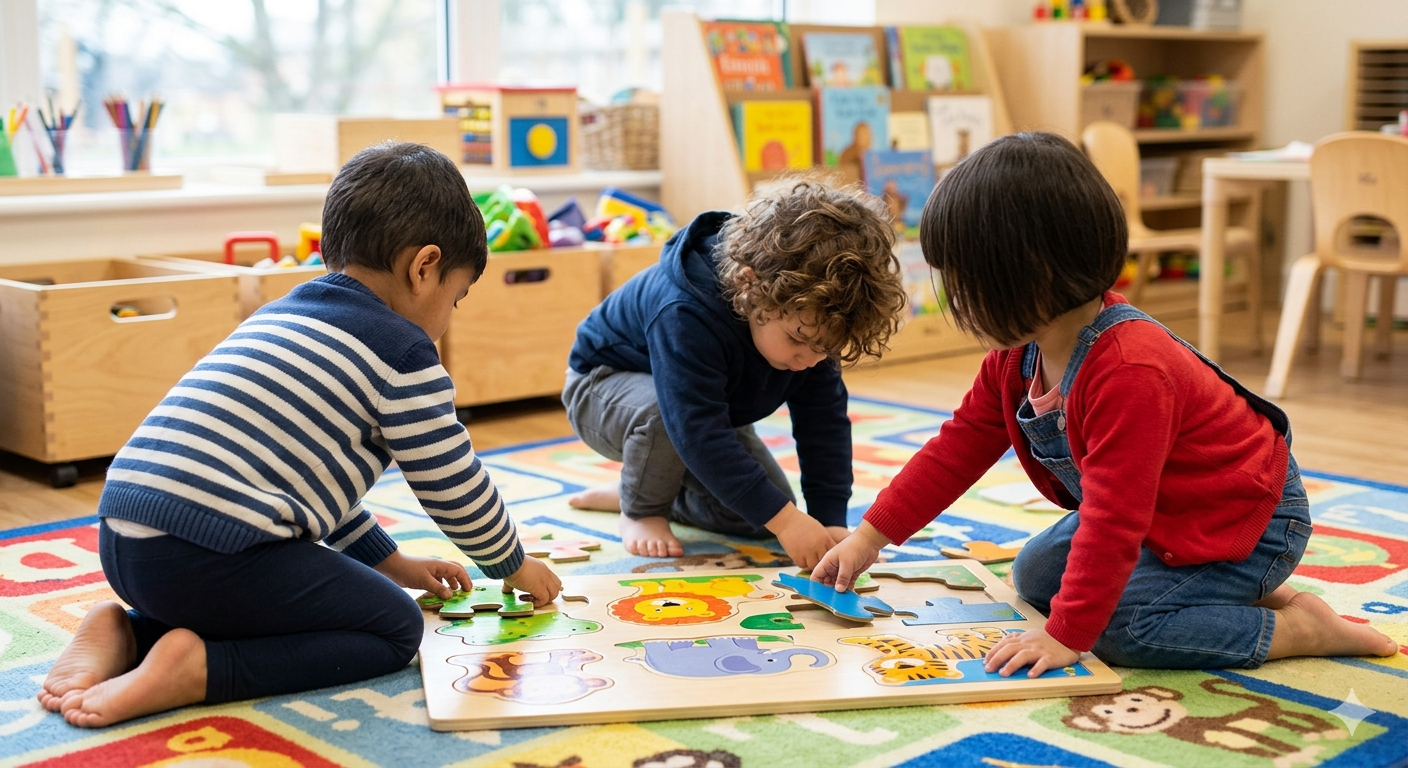
Attention refers to the ability to focus on a stimulus (a person, activity, or video) over a period of time to take in information and respond accordingly. Whilst attention span develops rapidly over the preschool years, it is important to note that a child’s level of focus can be influenced by several factors, including previous experiences, motivation, self-esteem, language development, specific diagnoses, or sensory integration.
The following information outlines the typical attentional expectations for preschoolers:
Two-Year-Olds
By the age of two, children are generally expected to attend to and concentrate on an activity of their personal choice for up to 6 minutes. At this stage, children will often "single-channel," meaning they ignore external stimuli completely to focus on the task at hand.
-
Age-Appropriate Activities: Simple puzzles, stacking blocks, posting games, matching pairs, and interactive books.
-
Ways to Increase Attention:
-
Sing nursery rhymes and occasionally leave a gap for the child to fill in the missing word.
-
Reduce environmental distractions, such as background TV noise or cluttered play spaces.
-
Repeat activities over time to build familiarity and confidence.
-
Three-Year-Olds
At three years old, a child is expected to sustain focus for up to 8 minutes. During this stage, they are still developing the ability to shift their attention. They often cannot attend to external stimuli (like someone speaking to them) while they are focused on an activity. However, their attention can be shifted with the help of an adult using verbal cues, such as "Look at this."
-
Age-Appropriate Activities: "Simon Says," musical statues, red light/green light, pretend play, and simple colouring or science experiments.
-
Ways to Increase Attention:
-
Gradually increase the length of story-time sessions.
-
Incorporate the child’s specific interests into new activities.
-
Use clear, simple instructions to allow them time to process information.
-
Promote interactive experiences involving movement and creativity.
-
Four-Year-Olds
By age four, children are beginning to control their own focus. A child is expected to be able to focus on one activity for up to 12 minutes. At this stage, they are mastering the ability to redirect their attention; for example, they can stop playing a game to listen to an adult's instruction and then return to their game.
-
Age-Appropriate Activities: Simple board games (e.g., Hungry Hippos), construction toys (Lego), and character-based role play.
-
Ways to Increase Attention:
-
Utilise short breaks between activities and incorporate movement.
-
Use timers to encourage engagement for specific periods.
-
Break larger tasks down into smaller, manageable "chunks."
-
Use visual or auditory cues, such as "First [Activity], then [Reward]."
-
Five-Year-Olds
By the age of five, children are developing the skill to integrate information from multiple sources for up to 18 minutes. At this stage, it is expected that a child can continue focusing on an activity while simultaneously listening to a speaker.
-
Age-Appropriate Activities: Scavenger hunts, strategic board games (e.g., Connect 4), storytelling about their day, and complex puzzles.
-
Ways to Increase Attention:
-
Use active, movement-based games like "The Floor is Lava" or freeze dance.
-
Use visual aids to reinforce attention during group activities (e.g., a teacher touching their lips to signal listening time).
-
Encourage them to reflect on and recount their week to build sequential memory and focus.
-
Resources:
Kid sense: Attention and concentration
Attention milestones
Developmental milestones in the early years
https://www.acecqa.gov.au/sites/default/files/2018-02/DevelopmentalMilestonesEYLFandNQS.pdf